


Insight

From Hype to Reality – Selective Industrialization of GenAI Begins
The 2026 CPO Annual Pulse Report | The State of Generative AI in Procurement
The second EFESO edition of the “CPO Annual Pulse Report – State of GenAI in Procurement” signals a clear inflection point. In 2026, organizations are moving beyond broad experimentation toward selective industrialization of generative AI. Interest remains high, but deployment decisions are now increasingly shaped by feasibility, value creation, and operational readiness.
This analysis draws on in-depth interviews with 50 Chief Procurement Officers from mid-cap and large organizations across diverse industries in Europe. Conducted between November and December 2025, these perspectives reveal both strategic priorities and practical experiences with GenAI adoption in procurement.
Operational Readiness: Experimentation Still Dominates
The data confirms that most procurement organizations remain in a learning phase. 75% are still experimenting, with 40% in early exploration and 35% running pilots. Only 20% report partial deployment, and just 5% indicate widespread adoption.
From Early Expectations to Economic Reality
The honeymoon phase is ending. GenAI is present across many organizations and widely tested, but scale remains limited. Early expectations of rapid, universal transformation have given way to a more grounded assessment. GenAI delivers value, but not systematically, not instantly, and only with significant structural effort. The “quick win” narrative that shaped 2024–2025 is gradually losing traction as organizations reassess what can realistically be industrialized.
Selective Industrialization Emerges
Optimism has not disappeared; it has become more focused. Leading organizations are converging on clearly defined use cases where GenAI demonstrates tangible impact, such as contract analysis, supplier intelligence, category insights, and spend classification. These organizations are progressing beyond pilots, but selectively, prioritizing proven value and feasibility over broad deployment.
2026 as a Year of Strategic Clarity
For European procurement, 2026 marks a phase of clearer prioritization. Experimentation has clarified what works and what does not. Attention now shifts to industrializing proven use cases, reinforcing enabling foundations, and making explicit trade-offs. The objective is no longer to deploy GenAI everywhere, but to deploy it where it meaningfully supports procurement performance.
The transition from hype to reality is underway, and procurement leaders are focused on turning proven use cases into scalable impact.
The GenAI Procurement Pulse and overall analysis directed by Gael Sandrin


Awareness Is Mainstream, but the Digital Divide Persists
Reported exposure to generative AI tools

Awareness of AI is now widespread. The vast majority of executives, employees, and even the broader public recognize that AI is actively shaping daily tools, workflows, and job expectations. This is reflected in the GenAI Procurement Pulse results, where 93% of respondents report having used generative AI at least once, and 70% indicate using it both professionally and personally. However, this shared exposure masks a persistent and increasingly visible digital divide.
The divide is particularly pronounced across organizational size. Regular use of GenAI for work reaches 83% in large enterprises, compared with 38% in SMEs, highlighting uneven access to tools, training, and organizational support. Large organizations continue to move ahead with dedicated budgets, specialized teams, and structured AI programs, while smaller organizations rely more heavily on fragmented experimentation driven by individual initiative rather than coordinated strategy.
This gap is also visible within organizations. While some employees benefit from training, advanced tools, and support, many others use AI sporadically, often outside formal processes and without guidance. As a result, usage remains uneven even where awareness is high.
The challenge is not simply access to a chatbot or license. It extends to ergonomics, data quality and relevance, data security, governance, human support, and the ability to redesign processes around these technologies. Without these foundations, awareness remains superficial: AI is widely discussed, but only a limited number of organizations convert it into consistent, measurable value.
Analysis by Laurent Coulon, Senior Partner
Investment Intent is Real, but Economic Selectivity Applies
Do you plan to launch new generative AI project in 2026?

Procurement organizations have moved beyond broad experimentation and are applying greater economic scrutiny to GenAI initiatives. After an initial wave of pilots, projects are increasingly assessed against value delivery and budget constraints , and opportunity cost.
The GenAI Procurement Pulse results illustrate this selectivity. While 53% of respondents plan to launch new GenAI projects in 2026, 33% remain in a wait-and-see position, and 14% do not plan to invest at all. This distribution confirms that GenAI has secured executive attention, but it has not yet become a default investment lever within procurement.
The primary constraint is economic credibility rather than technology maturity. Unproven ROI, combined with sustained budget pressure, shapes decision-making and forces GenAI initiatives to compete directly with established cost, cash, and productivity levers. In this context, experimentation alone is no longer sufficient to justify continued investment.
GenAI adoption is therefore likely to scale only when managed explicitly as a procurement value engine. This implies focusing on a limited number of high-impact use cases, establishing clear business ownership, and applying disciplined value tracking. Without these conditions, GenAI risks remaining a portfolio of pilots rather than evolving into a scalable performance lever for procurement.
Analysis by Marc Irmler, Manager
GenAI Focuses on Text Analysis - Multi-Agent Simulation Potential Remains Untapped
Where do you see the most value for generative AI in the procurement value chain?

Findings from the CPO Pulse Annual Report reveal a clear pattern in how procurement organizations prioritize GenAI across the value chain. Contract analysis and summarization stand out as the leading value area (69%), followed by sourcing and market intelligence (61%) and RFx automation (55%), confirming that early adoption gravitates toward use cases where GenAI maturity is already high.
Contract intelligence has therefore emerged as a natural entry point. Large language models excel at processing unstructured text, identifying legal clauses, and extracting obligations, making this a comparatively low‑risk domain that delivers tangible productivity gains—especially within the information‑dense source‑to‑contract phase.
Assisted negotiation, by contrast, is cited less frequently (35%) because realizing its value requires significantly higher system complexity. Effective AI‑supported negotiation goes far beyond applying a single language model: it requires integrating diverse commercial and market datasets—such as macroeconomic indicators, competitor intelligence, and historical negotiation outcomes—into a coherent context. On top of this, advanced negotiation environments increasingly rely on multi‑agent simulations that allow strategies to be tested, challenged, and refined before real supplier engagement. Because these elements are highly use‑case‑specific, they typically must be custom‑built, raising the initial adoption hurdle.
However, once such a data and simulation foundation is in place, it can be reused across categories and negotiation types, allowing organizations to scale impact efficiently.
Analysis by Dr. Konrad Hoppe
Pilots are Widespread, Scale Remains Elusive
What are the use cases for generative AI that are already deployed or being piloted in your organization?

The 2026 GenAI Procurement Pulse highlights a clear gap between experimentation and large-scale deployment of GenAI solutions. Many organizations are actively piloting use cases such as contract analysis, RFP drafting, and supplier intelligence, yet only a limited share has moved these capabilities into production.
This pattern reflects structural challenges rather than lack of interest. Pilots are relatively easy to initiate, but difficult to industrialize when data is fragmented, ownership remains unclear, or supporting processes are immature.
The GenAI Procurement Pulse data reinforces this pattern, showing a significant concentration of activity in pilot stages with far fewer fully deployed solutions. Integration into existing systems and workflows often requires more effort than initially anticipated, which slows deployment even when pilot results are promising.
In many cases, pilots remain technology-driven experiments rather than solutions anchored to clearly defined business problems, leading to limited sponsorship beyond the test phase.
Concerns related to data quality, regulatory compliance, and risk management further encourage organizations to limit deployments to controlled environments. Scaling becomes feasible only when pilots are designed with deployment in mind and clearly connected to measurable outcomes. A value-driven approach, rooted in concrete business opportunities and validated feasibility, increases the likelihood of moving from experimentation to sustainable scale.
Outcomes, the transition from experimentation to scale becomes more achievable.
Analysis by Valentina Zardoni, Manager
Only One in Three Organizations Is Fully Satisfied with Value Delivered
Are you satisfied with the value generated by generative AI project vs. the initial framing and investment?
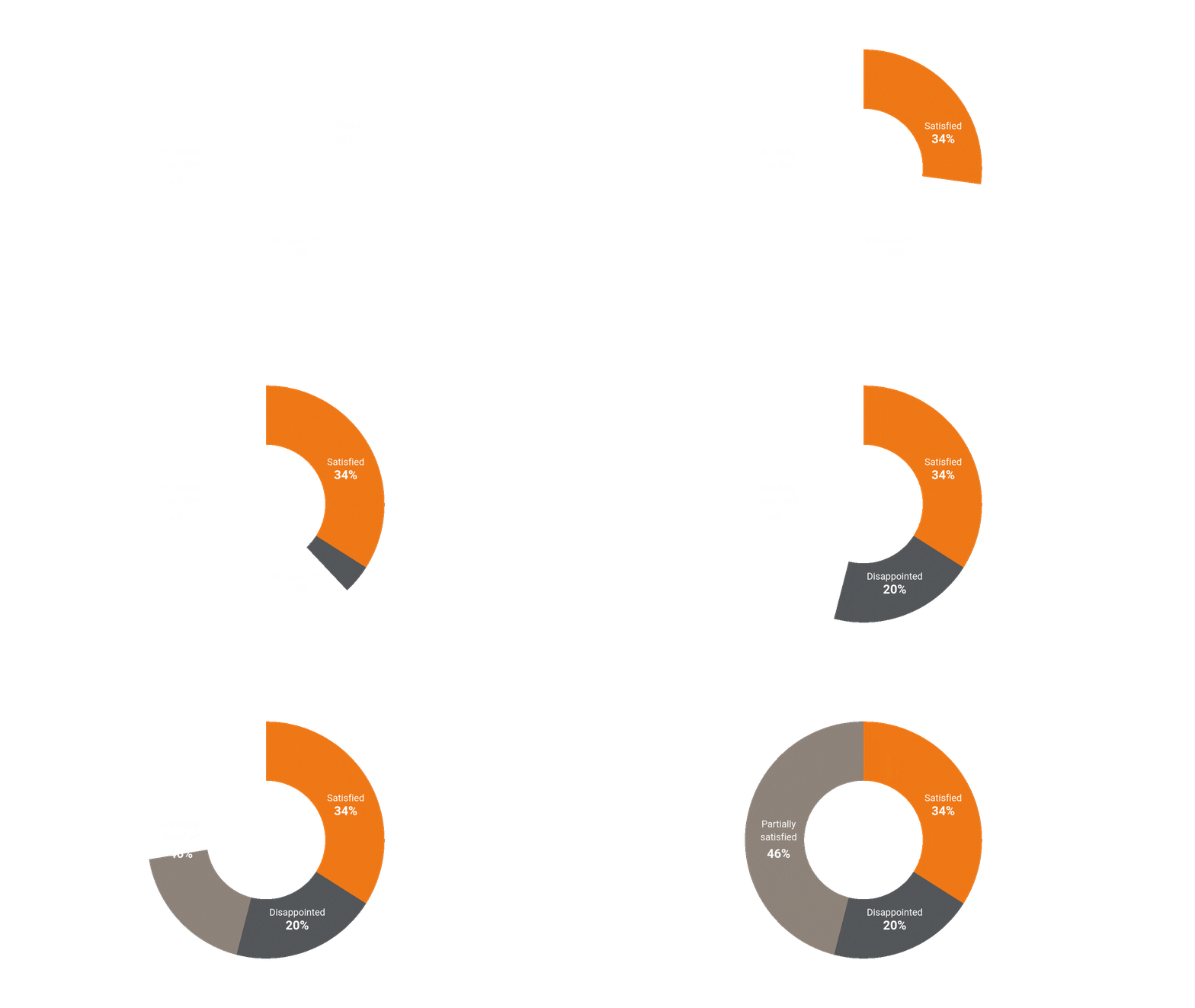
Satisfaction with GenAI outcomes remains uneven. Only 34% of respondents report being satisfied with the value generated . Nearly half indicate partial satisfaction, while one in five report disappointment. Relative to initial framing and investment, while 46% indicate partial satisfaction and 20% report disappointment. These figures underline a clear gap between expectations and realized outcomes.
Lower satisfaction levels can be traced back to a set of recurring and cumulative factors. Early expectations shaped by the initial hype around GenAI often proved unrealistic, particularly when anticipated quick wins failed to materialize. As pilots progressed, many organizations encountered structural limitations that constrained outcomes.
Data quality and fragmentation remain central challenges. Procurement systems frequently contain inconsistent, incomplete, or dispersed data, which limits the reliability of AI outputs and reduces the depth of insights generated. Integration with existing platforms further adds complexity and cost, especially when GenAI solutions are introduced as overlays rather than embedded capabilities.
Beyond technical constraints, organizational factors continue to influence perceived value. Skill gaps, resistance to change, and concerns related to role evolution or job security can slow adoption and reduce effective usage. At the same time, issues such as hallucinations, limited explainability, and regulatory compliance considerations erode trust and reinforce a cautious stance toward broader deployment.
Improving satisfaction therefore depends less on expanding the number of initiatives than on strengthening fundamentals. Organizations increasingly concentrate on high-impact source-to-contract use cases—such as supplier sourcing, RFx activities, and contract management—where GenAI maturity is higher and value is more tangible. This focus is typically accompanied by greater investment in data governance to clean, standardize, and secure information, enabling more reliable outcomes.
Targeted training and the sharing of procurement-specific success stories help build confidence and capability across teams. In parallel, phased deployment approaches, supported by structured change management and clear performance metrics, allow organizations to align expectations with achievable results. Over time, this disciplined approach supports more realistic value realization and helps close the gap between ambition and outcomes.
Analysis by Jamie Fowler, Principal
Trust, Data Security, and Compliance Shape Adoption Decisions
What challenges are you trying to mitigate?

Trust-related concerns remain a central constraint to GenAI adoption in procurement, and the the GenAI Procurement Pulse data makes this explicit. Data reliability and hallucinations rank as the top risk, cited by 68% of respondents as relevant and actively mitigated. This reflects persistent uncertainty around the consistency, accuracy, and explainability of AI-generated outputs, particularly in decision-support contexts.
Regulatory compliance and confidentiality closely follow, identified by 67% of respondents. Many organizations remain unclear about how data entered into GenAI systems is stored, reused, or transferred, especially in relation to GDPR obligations. This uncertainty reinforces a cautious stance, as procurement teams seek clarity on data sovereignty, auditability, and regulatory exposure before expanding deployment.
Beyond these top concerns, bias in decision-making is highlighted by 44% of respondents, underscoring apprehension about how GenAI may influence judgments in supplier selection, negotiation, or risk assessment. Vendor lock-in, cited by 39%, further reflects strategic hesitation, particularly when GenAI solutions are tightly coupled with proprietary platforms or ecosystem dependencies.
Team resistance to change, identified by 32% of respondents, remains a relevant but secondary concern. This resistance is often connected to the higher-ranked risks: skepticism toward AI outputs, uncertainty around accountability, and limited transparency can reinforce reluctance to modify established processes, roles, and decision rights.
Taken together, the results show that trust-related barriers are not isolated issues but an interconnected set of concerns spanning data reliability, regulatory compliance, bias management, and organizational adoption. Addressing them requires more than technical safeguards alone. Clear business cases, explicit governance rules, and structured change management play a central role in building confidence and enabling GenAI integration into daily procurement operations.
Analysis by Michele Bianchi, Partner
Productivity Gains Lead While Strategic Value Takes Longer to Emerge
Top objectives for organizations’ planned generative AI activities

Across procurement organizations, the first tangible impacts of generative AI are predominantly productivity-driven. The 2026 GenAI Procurement Pulse confirms that productivity (“lightness”) is the primary objective for 66% of AI high performers, far ahead of performance improvement in negotiation (35%), speed to market (13%), or risk reduction (7%). This distribution highlights where organizations currently expect—and observe—value.
In practice, GenAI is primarily applied to reduce friction in everyday procurement activities. Use cases such as offer analysis, contract and specification synthesis, RFx generation, internal knowledge leverage, supplier discovery, and day-to-day communication support are delivering immediate, visible benefits. These applications accelerate execution, increase consistency, and free up time without requiring deep structural change upfront.
This productivity-first trajectory is both intentional and rational. Organizations prioritize use cases that are faster to deploy, easier to adopt, and lower risk, particularly in early stages of GenAI adoption. As a result, productivity gains often serve as the entry point, creating momentum and familiarity across teams.
By contrast, strategic and performance-oriented value remains secondary at this stage, not because it is less important, but because it is structurally more complex. Use cases tied to supplier portfolio design, risk anticipation, should-cost modeling, negotiation performance, and knowledge continuity sit at the core of procurement decision-making. They require deeper data integration, process redesign, and governance alignment, which extends time to impact.
Digital scouting illustrates this progression. Initially, AI-driven market scanning delivers immediate time savings by accelerating supplier identification. Over time, as suppliers are qualified and integrated, the same capability contributes to improved performance, reduced risk, and increased sourcing optionality. In procurement, productivity is not the ceiling for GenAI value creation; it is the foundation upon which strategic impact gradually develops.
Analysis by Raphaël de Saint Vincent, Consultant
Skills and Data Quality Emerge as the Primary Bottlenecks
What poses the biggest challenge in capturing value from AI?

The GenAI Procurement Pulse results point clearly to non-technical barriers as the main constraints on GenAI value creation. Lack of skills and training (57%) and data quality and availability (55%) are identified as the two most significant challenges in capturing value from AI, ahead of system integration issues (41%) and unclear or immeasurable use cases (40%).
The skills gap is multifaceted. It extends beyond technical expertise to include leadership capabilities, business–AI translation skills, and the ability to mobilize teams around new ways of working. Effective GenAI adoption depends on human–AI collaboration rather than automation alone, which makes broad upskilling and change enablement critical for sustainable value creation.
Data quality represents a second, equally structural constraint. The challenge goes beyond data volume to issues of fragmentation, incompleteness, and accessibility across procurement systems. In many cases, relevant data sits outside organizational boundaries, further complicating usage rights and integration. Even strong AI capabilities are limited when underlying data is not fit for purpose.
Integration with existing systems, cited by 41% of respondents, reflects the complexity of embedding GenAI into real workflows rather than operating it as a standalone layer. Similarly, the lack of clear and measurable use cases (40%) highlights the ongoing difficulty of linking AI initiatives to concrete business outcomes early in the process.
Together, these findings suggest that capturing GenAI value depends less on advancing technology and more on strengthening fundamentals. Organizations that treat skills development and data foundations as strategic assets—supported by governance, feedback loops, and product thinking—are better positioned to move from experimentation toward sustained impact.
Analysis by Dr. Kenneth Sievers, Partner and Global Head of Procurement
Conclusion: From Experimentation to Disciplined Scale

The 2026 GenAI Procurement Pulse confirms that generative AI in procurement has moved beyond hype, but not yet into universal scale. Awareness is mainstream, pilots are widespread, and productivity gains are visible. Yet structural barriers persist: uneven access, economic selectivity, trust concerns, skills gaps, and fragmented data foundations.
2026 will not be the year of deploying GenAI everywhere. It will be the year of strategic clarity, where organizations concentrate on high-impact use cases, reinforce enabling foundations, and apply disciplined value tracking. Success depends less on technology maturity than on governance, data quality, and human capability.
Procurement leaders who treat GenAI as a value engine, not a technology experiment, will convert early wins into sustainable performance. The transition from hype to reality is underway, and the competitive gap will widen between those who scale selectively with purpose and those who remain in perpetual pilot mode.
Contributors






Explore the Report
Discover detailed insights on GenAI adoption in European procurement. Get actionable recommendations to accelerate your GenAI journey.
Be Inspired by More Insights & Events

Industrial Manufacturing
ROI- Return on Intelligence: Strategies for the Age of Intelligence
Transforming intelligence into competitive advantage through adaptive strategies, digital excellence, and smart production systems.

The State of Generative AI in European Procurement
This survey on generative AI in European procurement offers valuable takeaways to boost efficiency and unlock strategic value.

Humanizing Industry 4.0 Lessons Learned from Senior Executives
Empower your workforce by fostering collaboration between humans and machines, shifting from top-down control to a more inclusive, connected approach in digital transformation.

High Speed Supply Chain Management Supporting Profit, People and Planet
Transforming supply chains through digitization and synchronization to reduce waste, enhance profitability, and build sustainable operations.

The Future of QA Management
Leverage Generative AI to enhance deviation analysis, streamline CAPA processes, and foster proactive quality management across industries.

Private Equity
Maximizing Returns Through Smarter, Scalable Procurement Practices
Transformed fragmented procurement into strategic sourcing, delivering 20%+ direct spend reductions and 50% EBITDA increases for PE portfolios.

Aerospace & Defense
Private Equity
Industry Consolidation, Supported by its Major Players and Private Equity Funds, is Necessary to Secure the Supply Chain and Speed Up the Recovery
Aircraft suppliers face consolidation pressures and supply chain tensions post-Covid. EFESO guides transformation and M&A integration strategies.

The Future of Sustainability: Insights and Strategies From Business Leaders
Explored sustainability pressures on industrial CEOs through scenario planning, delivering four strategic breakthroughs for complete business model transformation.