




Fernando Assens
Managing Partner, Private Equity Practice

Insight

Most business in the world has been severely affected by the COVID-19 Pandemic. In addition to the constant threat of well-being and even life, businesspeople have lost their mobility, and have significantly curtailed the direct, face to face, interaction with customers, suppliers and other employees. This loss of familiar interplay in day to day activities has caused much inefficiency in even routine requirements of the business and has only been ameliorated in some industries by a more prominent use of technology.
COVID-19 — The Impact
But the greatest impact on the businesses has been the loss of revenue. The top line has been decimated because of the cessation of the normal business activity of buying and selling. This is a global phenomenon which is the by-product of country, federal, state and local containment measures, necessarily imposed to restrict the transmission of the highly contagious disease. No one can predict when things will return to normal. Revenue has disappeared by government decree in an attempt to save lives!
So, businesses must first survive, manage through the crisis, and then recover. Survival will depend on achieving sustainable liquidity until there is enough clarity to predict the return to normalized commercial activity, and then, an assessment of how much time it will take for a full recovery to occur. When will we have predictability? Survival will depend on focused cash management: bringing in cash and reducing or delaying expenditures. Managing through the crisis involves identifying and executing all business changes required to sustain survival until the end of the crisis. The speed of the recovery will define the future scale of resources that the business can afford. Survival, managing through the crisis, and recovery will require elements of business restructuring and business model redesign.
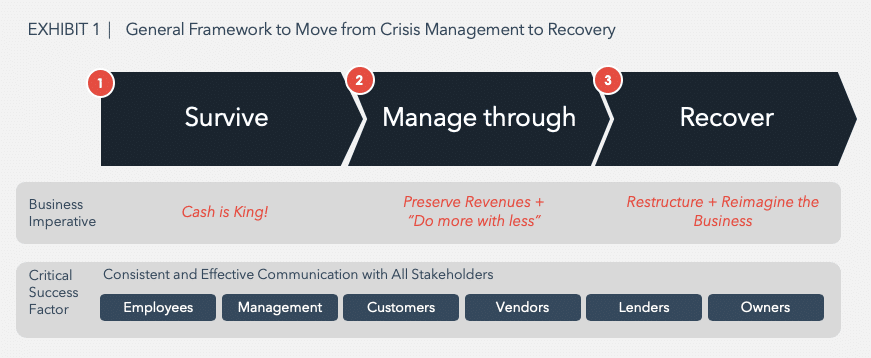
Throughout this three-step process (survival, managing through the crisis and recovery), the business must communicate continuously and effectively with all stakeholders of the business: Employees; Management; Customers; Vendors; Lenders; and, Owners.
All business activity must be focused on: Liquidity, Managing and Communicating through the crisis and Restructuring, Reengineering the business model.

Cash planning starts with a 13 week rolling cash forecast, designed to answer three questions:
Since no one has a crystal ball, we recommend developing a forecast based on a stressed revenue forecast and conservative expenditures. During this process, ideas must be developed regarding possible sources of cash inflows and opportunities to defer or eliminate expenditures. Specific areas to explore for cash generation and preservation are:
External Sources of cash
Internal Sources of cash
Once immediate measures have been taken to secure liquidity, a plan to sustain survival should be executed until the recovery phase is feasible. The plan should have at least 3 components and the following actions:
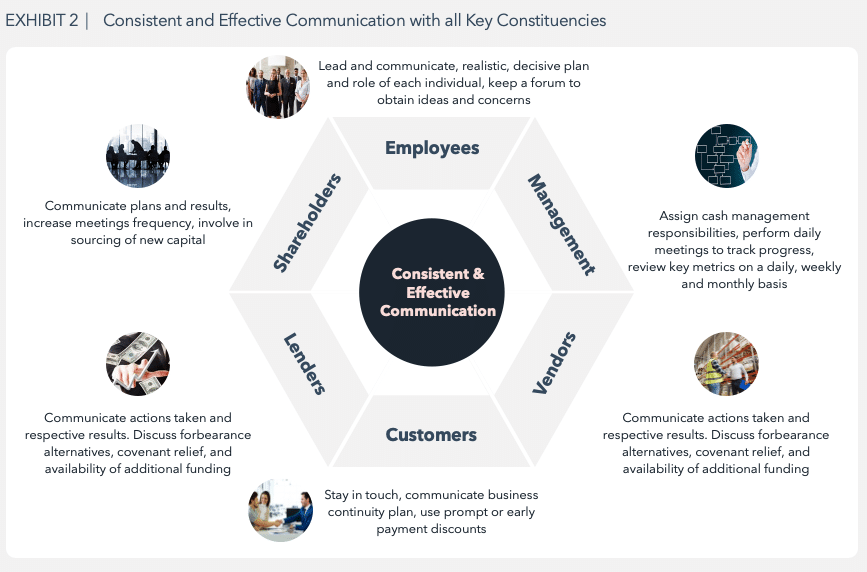
As plans are developed and more visibility is obtained, it is critical that communications take place with all constituencies of the business. In addition, it is also critical to install a Crisis Response Command Center that meets daily to address all parts of the plan. During times of physical separation, it is essential to go beyond the standard visual conference call, teams must use real virtual collaboration tools that enable visual dynamic problem solving and real-time management of tasks. EFESO has been facilitating teams using these types of tools for several years with great success.
Employees
Management
Customers
Vendors
Lenders
Owners (Board of Directors)
Once survival of the business is secured, and some predictability of future business activity is possible, the business must adapt to a scale that is affordable under projections of revenue and commercial activity. Under the current circumstances, when the COVID-19 crisis is over or at least manageable, businesses will be able to move forward. It is likely that the return to the level of pre-existing activity will take months, if not years. When this occurs, a complete restructuring of the business may be required.
The focus will then be on profitability as well as cash/liquidity management. A proper relationship must be established in the P&L components, matching expenses against expected revenues. This may require structural changes along with commercial and operational improvements.
Some of the restructuring activities that may be required during the recovery period are:
Structural Review
Commercial Review
Operational Review
Financing Review
Restructuring and business model definition is very complex in both planning and execution. Consideration should be given to retaining legal, accounting, business and restructuring advisors. Large companies might have in-house resources to handle the complexity, but mid-market companies will be challenged.
Fernando Assens
Managing Partner, Private Equity Practice

Jorge Mastellari
Senior Partner & COO

Fabian Rodriguez
Partner, Co-Leader Private Equity Practice Americas

Private Equity
Transform sustainability from compliance burden into measurable value creation for private equity portfolio companies.

Automotive and Commercial Vehicles
Private Equity
Automotive suppliers must embrace Industry 4.0 technologies to enhance efficiency, flexibility, and sustainability in operations.

Private Equity
Transforming PE portfolios through holistic ESG integration to maximize value, reduce risk, and profitably transition from gray to green.

Industrial Manufacturing
Private Equity
PE manufacturing firms exhaust quick wins; EFESO's holistic cost framework drives sustainable value beyond incremental gains.

Private Equity
Proactive operational assessment streamlines exit process, addresses value leaks, and maximizes deal value for sellers.

Industrial Manufacturing
Private Equity
Extended holding periods demanded deeper operational improvements beyond initial gains, delivering accelerated value through footprint optimization and lean transformation.

Private Equity
Reconfigured PE portfolio networks and facilities, delivering 20-40% cost savings and 6-10% EBIT increase.

Automotive and Commercial Vehicles
Food & Beverage
Private Equity
Transformed fragmented procurement into strategic sourcing, delivering 20%+ direct spend reductions and 50% EBITDA increases for PE portfolios.