


Chuck Deise
Senior Partner, Growth Industries

Insight

In today's margin-pressured environment, most companies recognize the need to improve productivity and reduce costs. However, many respond solely with reactive, fragmented, and unsustainable cost-cutting initiatives that can impair growth. Rather than settling for superficial savings, companies must structurally reshape their cost base to unlock long-term enterprise value. This means pursuing cost optimization in tandem with value creation.
Even in mature businesses with previous cost initiatives, structured and strategic approaches continue to uncover savings while enabling reinvestment. Smart cost takeout is both an operational lever and a long-term value driver.
In today’s margin-pressured environment, most companies recognize the need to improve productivity and reduce costs. However, there is a heightened sense of urgency given the impact of tariffs and overall economic uncertainty. Rising material, labor, and logistics costs are impacting earnings and squeezing profits. A knee-jerk response is to “cut costs,” but such initiatives are usually reactive, fragmented, and ultimately unsustainable and damage potential for growth.
What’s needed to address today’s challenging business conditions is cost optimization that goes hand in hand with value creation and positioning for growth. A smarter cost takeout approach is strategic, meaning it is aligned with long-term business goals and growth plans. It is also data-driven, as it is built on proprietary benchmarks, activity-based cost models, and operational diagnostics. Furthermore, it is sustainable, because it is embedded into ways of working rather than being limited to adjustments in budget lines. The true opportunity lies not in superficial savings, but in structurally reshaping the cost base in order to unlock long-term enterprise value.
The Problem:
In today’s margin-pressured environment, most companies recognize the need to improve productivity and reduce costs. However, many respond solely with reactive, fragmented, and unsustainable cost-cutting initiatives that can impair growth. Rather than settling for superficial savings, companies must structurally reshape their cost base to unlock long-term enterprise value. This means pursuing cost optimization in tandem with value creation.
The Solution:
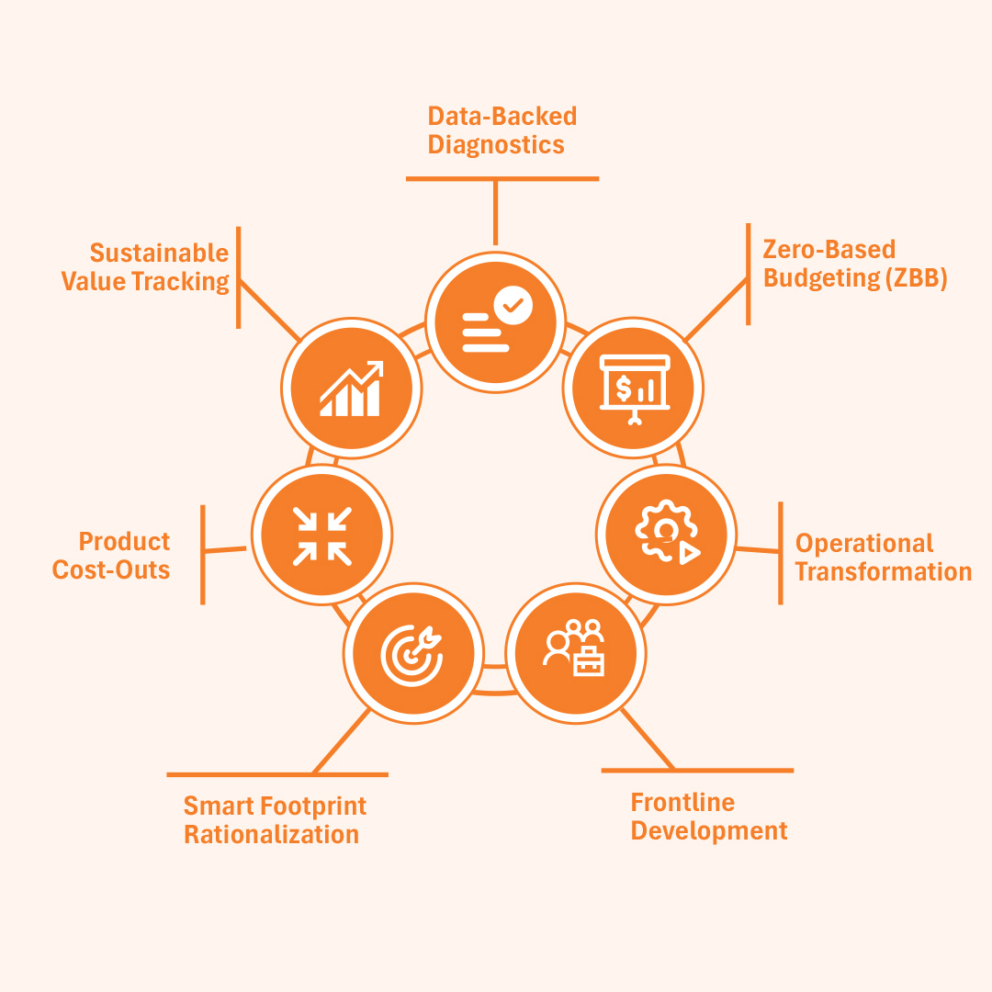
To achieve this, companies are leveraging a set of corporate capabilities that rigorously address both short-term cost-savings opportunities and long-term strategic growth. These include:
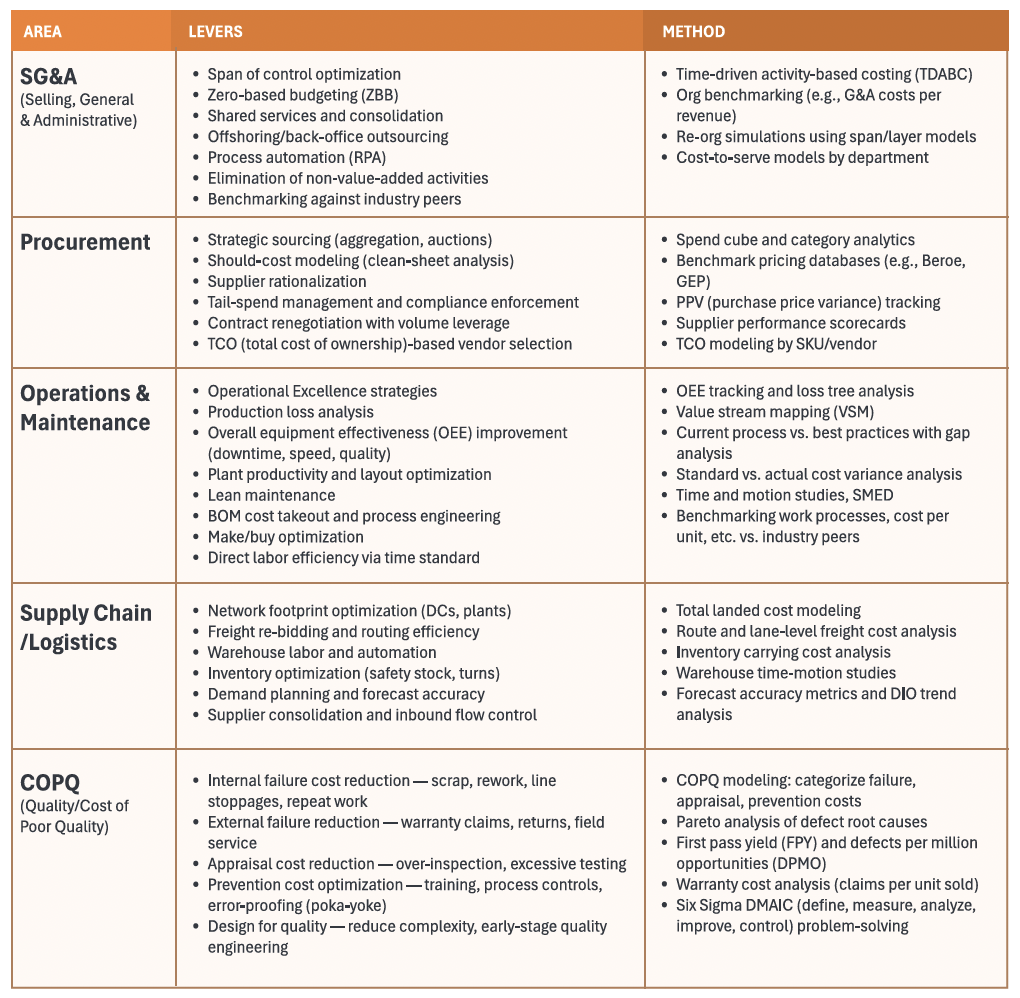
By applying these capabilities, organizations can systematically target common cost areas, pull specific levers, and deploy tailored improvement methods. The most immediate and substantial savings are typically realized in SG&A, procurement, operations and maintenance, supply chain, and quality.
Other areas, while requiring more time to execute, yield meaningful savings over the long term—such as product development, capex optimization, and SKU rationalization. Additionally, current events and the organization’s structure may create opportunities for significant cost reduction in information technology, sales and marketing.
When taken together, these areas represent a powerful opportunity for overall cost reduction. Across industries, companies have achieved total savings of at least 20–25% of operating expenditures.
Examples of Impact:

Opportunities to reduce costs in a company range from quick hits that deliver much-needed near-term relief to strategic decisions that drive long-term savings and value. These savings are found in the cost of goods sold, such as direct material, labor, and overhead, as well as in operating expenses that impact operating profitability and EBITDA, including sales and marketing, administrative, and R&D costs.
Corporate capabilities being wielded to rigorously address all potential opportunities today while preparing for a value-driven future include:
All companies share common cost structures and can pull levers for cost reduction specific to each area, such as the use of shared services and consolidation to address SG&A costs. Levers are supported by a wide range of improvement methods tailored to each cost category, like total-landed-cost models to facilitate footprint optimization of the supply chain.
Most companies find the largest and fastest savings in areas of SG&A, procurement, operations and maintenance, supply chain, and quality. Other areas take longer to execute but also can deliver sizable savings, such as product development, capex optimization, and SKU rationalization. Additionally, some areas offer substantial cuts based on current events and organizational structure, including information technology, sales and marketing. Taken together, these areas present significant overall savings.
The primary objective in targeting these areas is cost savings. However, this does not necessarily mean headcount reduction. In fact, true cost optimization may involve preserving, or even expanding, staff to unlock and sustain value. For instance, enhancing procurement processes rarely leads to large layoffs, and boosting throughput typically requires maintaining current personnel to support higher sales volumes. Similarly, selectively adding production lines or opening new facilities as part of a network-footprint strategy can actually increase the workforce rather than shrink it.
In dynamic business environments, workforce strategy must balance financial goals with company culture. The following five scenarios illustrate typical headcount implications:
Companies that routinely analyze and optimize cost structures and establish new operational strategies and programs to drive performance improvement, position themselves for growth. They achieve quick wins such as immediate cost reductions and operational improvements. In addition, they enable longer-term benefits through transformed processes, systems, and footprints that ensure ongoing value-add and cost containment. Most importantly, they achieve cost savings of up to 20–25% of operating expenditure (OpEx) spending, which boosts the bottom line and puts them at a competitive advantage.
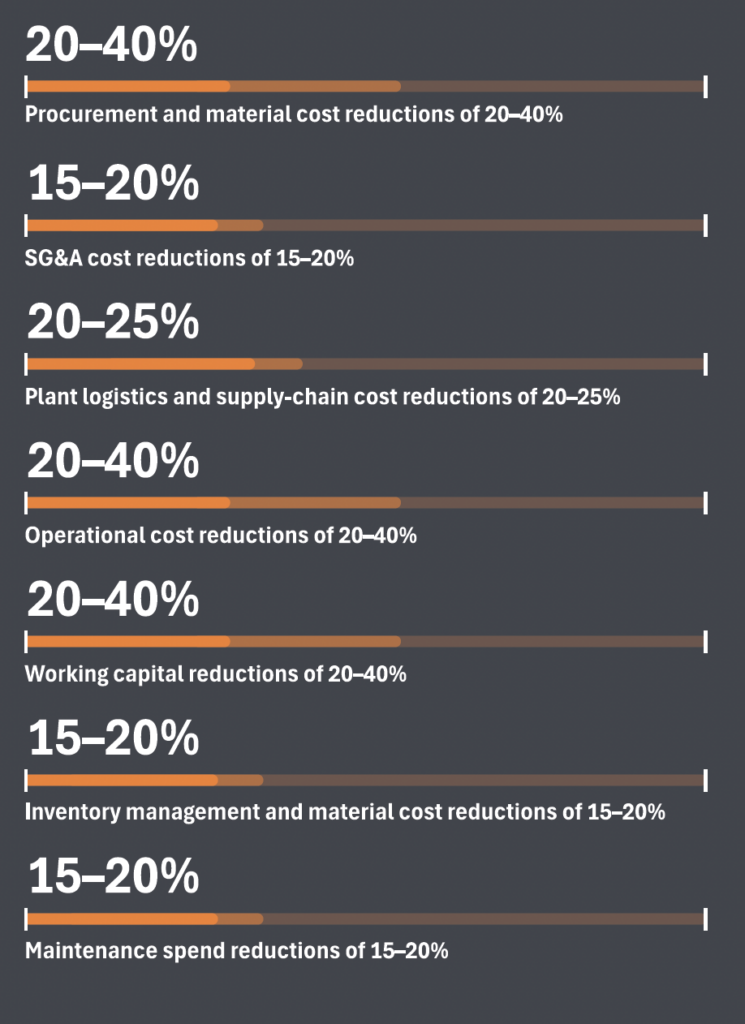
Cost optimization should be viewed not merely as a response to pressure but rather as a catalyst for transformation. Companies across many industries are achieving short- and long-term savings beyond what they previously thought possible. The following examples highlight how this impacts the bottom line:
New Organizational Model and Operating Standards in the Chemical Process Industry: With mounting cost pressure, underperforming assets, and disjointed organizational structures and work processes across many global sites, a chemical company had to transform operations to survive. The company developed new operating standards and an organizational model that was deployed globally to run, improve, maintain, and operate safely with highly reliable assets that predictably deliver quality products. A robust change management program was also implemented to shift the culture and drive sustainment. This transformation program accelerated productivity and cost reduction, improved quality, and gained additional capacity release, leading to a $50 million EBITDA improvement annually and a sustainable foundation to drive future growth.
Cost Capture and Process Improvements in Equipment/Automation: An equipment/automation company identified up to $3.4 million (12% of total OpEx) in potential savings across a network of six plants that could be achieved in the near term. Four opportunities could be addressed immediately by capturing direct, indirect, and SG&A savings, yielding approximately $600,000 in annual reductions. The remaining 80% required process improvements, but overall, more than 50% of savings could be achieved within six months and nearly all savings captured within nine months.
AI-Enabled Data Analytics in Automotive: A procurement-focused project at an off-highway automotive company resulted in savings of €30 million (approximately 16% savings on the total purchases of the company). Using an AI analytical toolbox, contracts with approximately 175 suppliers were reviewed and revised in just three weeks.
Lean Transformation for Oil and Gas: Multiple lean initiatives were undertaken at the largest site of a refinery company, as well as at two additional sites. The initiatives focused on waste elimination, visual management, and front-line KPIs in the maintenance areas. Workflow improvements reduced contractor headcount from 900 to fewer than 350 at one site and resulted in more than $100 million in savings (13% of Total OpEx).
Even during tough times when the most obvious cost areas have already been targeted, opportunities remain to deliver needed savings without inhibiting growth enablers. A smarter cost strategy is a transformation that allows companies to enter the next upcycle stronger, faster, and more focused than competitors. The emphasis should be on building a leaner, more resilient organization that is fully prepared for what comes next.

Smarter Cost Takeout Today, Strategic Positioning for Tomorrow
Chuck Deise
Senior Partner, Growth Industries

Jorge Mastellari
Senior Partner & COO

Bruce Work
Senior Vice President & Partner, Private Equity

CJ Renegar
Partner, Oil & Gas and Energy

David Sedge
Partner, Chemical Industry

Iñigo Acha Orbea Bayon
Senior Consultant

Chemicals
Move from short-term cost cuts to sustainable cost transformation in chemicals and unlock lasting savings through structural efficiency.

Industrial Manufacturing
Oil & Gas, Sustainable Energy
Explored sustainability pressures on industrial CEOs through scenario planning, delivering four strategic breakthroughs for complete business model transformation.

Automotive and Commercial Vehicles
Automotive electrification disrupts traditional supply chains. EFESO quantifies impact across nine vehicle systems, revealing strategic repositioning imperatives for suppliers.

Industrial Manufacturing
Transforming intelligence into competitive advantage through adaptive strategies, digital excellence, and smart production systems.

Chemicals
Mastered Predictive Maintenance in chemicals through agile Proof of Value, delivering higher OEE and lower costs.

Industrial Manufacturing
EFESO surveyed 150 manufacturing executives across North America to have a comprehensive view of the decisions shaping manufacturing’s future.

Automotive and Commercial Vehicles
Private Equity
Automotive suppliers must embrace Industry 4.0 technologies to enhance efficiency, flexibility, and sustainability in operations.
