Watch the video

Insight

Unlocking Capacity Under Ramp-Up Pressure
Europe’s defense market has shifted into a new pace. Budgets are rising, programmes are moving from announcements to contracts, and customers expect delivery dates they can rely on. The mix is also getting more complex: higher build rates, upgrades, spares, and MRO are all running in parallel. At the same time, the system around operations is under strain. Skilled labour is tight, suppliers are stretched, qualification and compliance requirements add lead time, and CapEx is harder to approve and even harder to execute on schedule. For many COOs, this pressure shows up in two areas.
First, production ramp‑up and on‑time delivery: getting rate increases through the factory without creating delays, quality escapes, or rework loops.
Second, industrial footprint and CapEx execution: expanding or reshaping capacity fast enough, with the right site setup, and without losing control of cost, timing, and governance. And behind both sits the same reality: A&D order books are growing faster than factories can respond
How to significantly increase production performance without major capital expenditure. In many plants, the fastest capacity is hidden inside today’s machines and lines. The gap comes from unstable performance, long changeovers, quality loops, and bottlenecks that move every week. COOs need results quickly, with minimal disruption and without waiting for new equipment.
• Which bottlenecks truly limit output and where “invisible capacity” is trapped?
• How to lift throughput with low-disruption actions on cycle times, setups, maintenance, and parameters?
• How to stabilize performance across shifts so gains translate into reliable delivery?
• How to prove impact fast with clean data, and keep the improvements in daily routines?
Each decision directly impacts throughput, cost per unit, and on-time delivery. Every COO faces the same challenge.
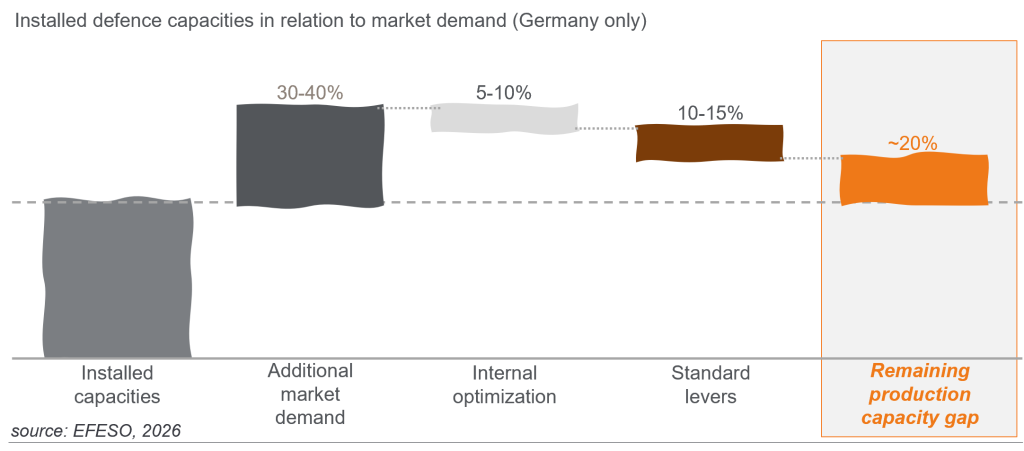
Industrial companies invest significant effort into improving their production performance. Continuous improvement programs are rolled out, value streams are companies respond with internal optimization measures that unlock an additional 5-10%. Standard efficiency levers then contribute another 10-15%. optimized, shift models are adjusted, and production lines are rebalanced to avoid bottlenecks. In many cases, targeted investments into equipment and line upgrades are added to further increase scalability. These measures are proven, well-established, and necessary. They create transparency, reduce waste, and improve the structural performance of production systems.
However, even when all these levers are implemented consistently and professionally, many organizations experience the same phenomenon: a significant production gap remains. Typically, installed capacity is designed for a certain market demand. As demand increases by 30-40%, Yet, after all these efforts, a remaining gap of around 20% often persists between what the production system should be able to deliver and what it delivers in daily operations. This gap is rarely caused by missing investments or poor planning. Instead, it is rooted in operational realities on the shopfloor: micro inefficiencies, hidden time losses, suboptimal machine behavior, and unstable routines that are invisible to traditional improvement approaches.
Bridging this final ~20% production gap requires a different type of intervention – one that is precise, analytics-based, and tailored to real operational constraints
To address exactly this hidden performance potential, EFESO developed the Performance Booster. It focuses on uncovering and eliminating the operational losses that remain invisible to traditional efficiency programs. The methodology combines advanced diagnostics, smart machine optimization, and sustainable routine stabilization into a structured, fast-acting intervention.

In most cases, the data driven stabilization of routines has already been implemented within the organization. Standardized work routines, visual management systems, and real time feedback loops provide operational transparency and discipline. This foundation ensures that improvements can be sustainably anchored.
Our added value builds on this baseline through two additional performance levers. The first lever is software-based machine tuning. Through rapid pre analysis and offline preparation, adaptive feed control software can be deployed within the same day. This allows real time optimization of machine behavior without mechanical modifications or increases in speed limits. Performance gains are immediately validated through production data and cut check analysis.
The second lever is AI based video performance diagnostics. By analyzing production sequences with advanced video analysis tools, micro inefficiencies and nonproductive time become visible at a level of detail that conventional data analysis cannot capture. These insights are translated into a concrete and actionable implementation plan together with the customer team.
The results speak for themselves. Projects typically achieve around 9-13% cycle time improvement, 8-11% output increase, and a throughput impact within four weeks. Overall, efficiency gains of around 20% can be unlocked, without major investments and without structural changes to the production system. By leveraging deep operational expertise and advanced analytics, EFESO’s Performance Booster enables industrial companies to navigate ramp-up complexity, unlock hidden potential, and close the operational performance gap with confidence.
For aerospace and defense COOs, this challenge is amplified by long product lifecycles, stringent certification constraints, sovereign requirements, and fragile tier-n supply chains. Performance is no longer driven by isolated productivity initiatives, but by the ability to orchestrate industrial excellence across programs, suppliers, and plants while absorbing demand volatility, workforce scarcity, and geopolitical risk. Leaders who succeed are those who redesign operations with execution discipline, resilience by design, and scalability embedded from the start, turning operational complexity into a strategic advantage rather than a constraint.
Watch the video

Food & Beverage
Food & Beverage Margins: Where Cost Pressure Becomes Margin Leakage

Consumer Goods and Luxury
As inflation and cost pressures persist, Consumer Goods and Luxury companies are rethinking operational cost reduction to protect margins, improve service levels and drive sustainable performance.

Aerospace & Defense
Discover what’s really blocking flow in your MRO operations. Execution discipline, not assets, is what drives throughput under variability.